

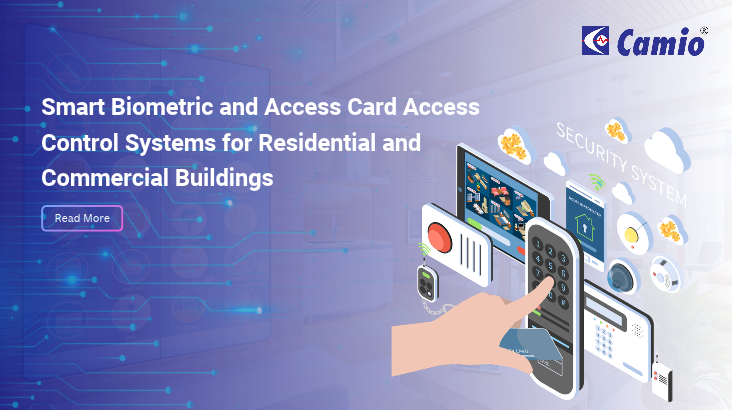
Conventional keys and passcode access are not reliable enough today. Therefore, property owners are looking for smarter ways to make access to their properties more secure and convenient. Their search ends at biometric access control systems and access cards. These access systems safeguard the entrance, record each entry, and make daily life more convenient.
In this blog, you get an idea of how both technologies work, where each one fits best, and how to choose smarter.
What is a Biometric Access Control System?
A biometric access control system uses an individual’s physical traits, including fingerprints, face, or iris, to validate identity. The system compares a live scan against a stored template. When both of them match, the door gets unlocked. The system denies entry if they don’t match and logs the attempt.
Here is how the process works:
Enrollment – The access system scans a physical trait and stores it as an encrypted template.
Verification – The reader captures the scan at the door.
Decision – Both scans are compared by the software, and it sends an unlock signal.
Logging – The platform also records who entered, where, and when.
Your fingerprint cannot be copied, lent, or forgotten, unlike keys. This is the main reason why more people are adopting biometric access control systems.
How Access Card Systems Work
Access cards make use of RFID or smart card technology. When users tap the card against the reader, the controller checks permissions. Cards are also chosen by many property owners as they are familiar, affordable, and easy to issue in bulk.
However, not every card guarantees equal protection. There are cards that are increasingly phased out for access control, while certain cards are becoming standard. As many real-world weaknesses come from configuration and system-level design, even the modern cards require care. So before buying anything, buyers should ask vendors about the encryption and key management.
Biometrics Vs Access Cards: Which is Better?
Neither of the access measures wins every time. Each one solves a different problem.
- Biometrics validates the person. Therefore, it is ideal for labs, master bedrooms, and server rooms.
- Cards verify the credential. It suits high-traffic lobbies and large teams.
- Combined systems need both. Thus, a stolen card alone will never open the door.
This layered approach was recommended long ago by security professionals.
Residential Access Control Systems: Safer Homes and Societies
Residential access control systems safeguard and secure gated communities, parking areas, apartment lobbies, and individual flats.
This helps the residents with the following:
Keyless convenience: Members can enter the building with a touch or a glance.
Visitor control: Guests get temporary access that automatically expires.
Entry records: Executives can monitor who came and went.
Instant revocation: A lost card stops working in seconds.
A single platform can manage the complete entrance experience from a phone. Smart access control systems for homes and offices connect with video doorbells, lighting, and intercoms.
Smart Access Control Systems for Homes and Offices
As offices manage a lot of people across several time zones, they deal with different challenges. With modern platforms, these challenges can be handled well.
Administrators are able to:
- Allocate access based on role, shift, or department
- Restrict access to sensitive areas to certain employees
- Add or remove users from a single dashboard
- Immediately pull attendance and audit reports
At the same time, cloud-based management allows support teams to remotely control different sites. Also, biometric terminals prevent employees from clocking in for another. This way, many companies consolidate access control with attendance tracking.
How to Choose the Right System?
Review the following points before you choose
Security Level – Align the technology based on the risk. Critical zones require biometrics, and for general areas, cards are enough.
Liveness Detection – Select Readers that can identify fake fingerprints and photos. Liveness detection can spot genuine biometric samples from spoofed ones.
Backup Access – Plan for power cuts and network failures.
Scalability – Choose software that can grow with your building.
Integration – Ensure compatibility with alarms, CCTV, and visitor management.
Support – Pick an installer that offers maintenance and training.
Key Insights
Strong identity assurance is offered by biometric access control systems, while speed and affordability are delivered through access cards. Combining these two access controls forms a flexible security layer for any property. The appropriate access control system or office solution safeguards people and the building and streamlines everyday operations, regardless of whether you take care of a villa, a corporate floor, or an apartment complex. You can begin with a simple risk assessment and map your entry points and users. Further, you can choose the technology that balances security, budget, and convenience.
Ready to secure your property? Contact Camio Automations for a quick security assessment and get a clear recommendation on the smart access control system that aligns with your building.