

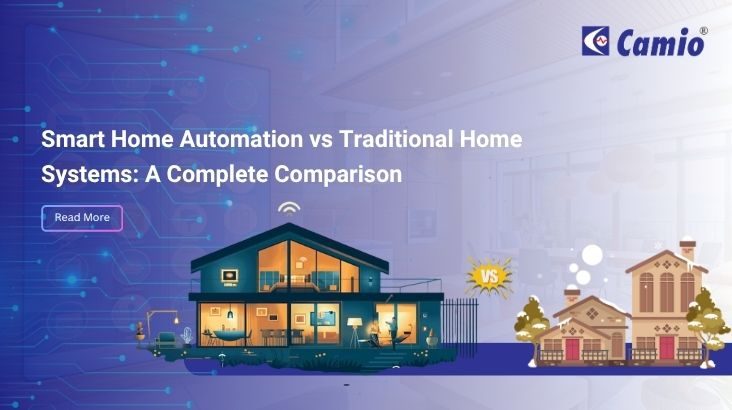
Consider you are buying a home. According to your perspective, what matters the most to you? Is it the familiarity or simplicity the home offers, or the comfort and convenience the advanced technologies in the home provide? Well, the requirements and concerns of homeowners are constantly changing. Therefore, the confusion on choosing between a smart home vs traditional home is highly significant today. By choosing traditional homes, you get a straightforward and reliable living experience. Whereas, with the connected technologies and automation, smart home solutions optimize efficiency, comfort, and control. Both traditional home systems and smart home technology offer their own distinctive benefits, choosing between them is completely based on the needs, concerns, and lifestyle of the people living in it. Some people prefer the simplicity and familiarity of traditional systems, while others are turning towards the rising benefits of home automation systems. A detailed comparison of smart home vs traditional home systems gives a clear understanding of which approach better suits each one’s preferences, lifestyle and future expectations. So let’s explore.
Smart Home Automation Vs Traditional Home Systems
Convenience and Control
The level of convenience offered by smart homes and traditional homes is the biggest difference that distinguishes the two. In traditional homes, the lights, security devices, air conditioning, and other appliances are all controlled manually. This takes time and is an effortful task, especially for those who live in larger homes. However, people who live in smart homes are not bothered by any of these. Smart home automation enables the homeowners or the residents to handle multiple processes effortlessly through a voice command or smartphone. Based on user preferences, the automation systems in smart homes can adjust temperature, entertainment settings, and lights automatically.
Energy Efficiency and Cost Savings
As the lights, air conditioners, and appliances keep running in traditional homes even when they are not required, it results in more energy consumption. Because traditional home systems must manually monitor energy usage, as they lack automation capabilities. In contrast, through intelligent control and scheduling features, smart home technology assists in optimizing energy consumption. The automation system monitors and switches off unused lights, adjusts thermostats based on occupancy, and tracks electricity usage in real time. Homeowners can mitigate energy wastage and utility bills and contribute to a more sustainable and environmentally friendly lifestyle through effective smart home automation.
Security and Safety
Security is a major concern in every home. The conventional security measures in traditional homes rely on standalone alarms, manual locks, and limited monitoring capabilities. Even though these traditional home systems offer basic protection, they may offer remote access or real-time alerts. On the contrary, smart home solutions consolidate surveillance cameras, automated alerts, smart locks, and motion sensors into a consolidated platform. Using smart home technology, homeowners can remotely monitor their property and get immediate notifications about unusual activity. This helps in increasing security and peace of mind, it also allows faster responses to potential threats.
Implementation Cost and Long-Term Value
Traditional homes rely on basic appliances, standard electrical wiring, and manual controls; therefore, there will be a lower initial installation cost. Homeowners only have to spend less during construction or renovation. In comparison, there will be a substantial upfront investment for smart home automation in connected devices, controllers, sensors, and consolidated home automation systems. But focusing solely on the initial cost may overlook the long-term benefits. The advanced smart technology enables homeowners to mitigate energy consumption, minimize maintenance issues, enhance security, and improve daily convenience. Gradually, these facilities can increase the property value and generate considerable savings. Therefore, smart homes are also valued as a long-term investment that offers lasting value apart from the initial implementation cost.
Future Readiness and Property Value
In case of future readiness and property value, smart homes have more demand than traditional homes. Because traditional homes may not meet the technology and more convenience-focused expectations of customers. As it only has basic technologies that are operated with manual effort. At the same time, smart homes have most of the advanced technologies that are automated. The buyers view it as more efficient, advanced, and future-ready than traditional homes. Some of the buyers look for the security, convenience, and energy-saving benefits offered by smart homes. Therefore, investing in smart home solutions can increase property appeal, market value, and guarantee that homes remain significant.
Bottom Line
Choosing a smart home vs traditional home is completely dependent on the individual preferences, priorities, and requirements. Each one offers its own benefits, the conventional or traditional homes have the familiarity, simplicity, and lower upfront costs. At the same time, the convenience, automation capabilities, and connectivity offered by smart home automation are preferred by many. Even though many explore the growing benefits of home automation, traditional home systems remain a practical choice for many. Homeowners have many options to choose from nowadays as smart home technology and smart home solutions are growing continuously. Understanding the strengths, considerations and each individual’s preferences helps you make the right decision.
Are you ready to upgrade your home with smart home solutions? We can help you! Connect with Camio Automations now!