

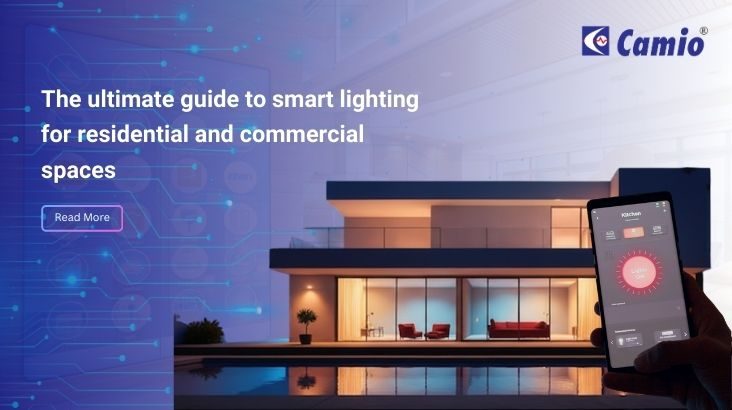
When we talk about smart lighting, it isn’t just about some fancy bulbs, turning to blue from purple and then to red. Instead, it’s about engineering excellence, blending in automation, control, efficiency, and intelligent energy management in one package. From houses to offices, retail stores, and even industrial complexes, wireless smart lighting automation has an indispensable role in optimizing costs and shaping an immersive experience.
However, investments in smart lighting for homes and offices require clarity. That being said, let’s make some intelligent decisions based on the guide we have crafted for you.
Smart lighting in residential spaces
When we talk about homes, smart lighting focuses on personalization, comfort, and convenience. Installing the LEDs or bulbs isn’t just a way of uplifting your standards of living. Rather, it’s integrating automation control and efficiency in everyday living.
A well-orchestrated residential smart lighting setup offers innumerable benefits to the homeowners. Here’s how!
- Reduced electricity consumption through LED dimming and scheduling, thereby preventing unnecessary full-power operation throughout the day.
- Scene-based control that adjusts brightness and color temperature instantly, allowing different moods without manual recalibration.
- Remote access via mobile applications to enable smart lighting management even when physically absent from the site.
- Voice-enabled interaction with integrated assistants to simplify operations and cut off dependency on manual switches.
- Automated security simulation in vacant houses to create the illusion of occupancy and deter trespassers.
Proper zoning with smart lighting systems makes a huge difference. Living rooms, for instance, benefit the most from layered lighting, while kitchens usually need task-focused brightness. Similarly, bedrooms require dim-to-warm transitions for better nighttime comfort.
Smart lighting in commercial spaces
Every traditional lighting component installed at offices, retail stores, warehouses, or healthcare facilities consumes way more energy than residential ones. This is where commercial smart lighting comes into play, cutting down costs dramatically through the ways described below.
- Occupancy-based automation that switches the lights off in the unused zones, thereby reducing energy consumption in vacant meeting rooms, corridors, and storage rooms.
- Daylight harvesting controls adjust artificial lighting automatically to maintain consistent brightness while minimizing electricity usage.
- Centralized monitoring dashboards for multi-floor or multi-location management allow facility managers to control smart lighting systems from a unified portal.
- Real-time energy tracking flags inefficiencies and enables data-driven cost optimization decisions.
- Predictive maintenance alerts slash downtime by identifying fixture or driver issues before complete system failures.
Types of smart lighting systems
Choosing the right lighting automation system will depend on property size, infrastructure readiness, and future expansion goals. Below are some of the most common options you can explore further.
- Wi-Fi-based systems that are easy to install and hence ideal for small homes. However, they are not suitable for large-scale, reliable setups.
- Z-Wave mesh networks or Zigbee offer stronger connectivity across bigger residential properties, thereby ensuring stable device communication.
- DALI-based wired systems are designed for commercial buildings and offer high scalability and centralized programming.
- Hybrid IoT-integrated systems combine local control with cloud analytics, enabling advanced automation and reporting flows.
Design factors that influence performance
Technology alone cannot guarantee success for smart LED lighting setups. Rather, planning also plays an indispensable role in this aspect. Hence, before installation, consider the below areas.
- Clear zoning between task, ambient, and accent lighting is necessary so that automation doesn’t compromise functional needs.
- Pre-defined automation logic based on real usage patterns instead of adding controls without a clear purpose.
- Strong and stable network infrastructure, especially for wireless systems that rely on uninterrupted connectivity for performance deliveries.
- Future scalability requirements to ensure the systems can expand without complete replacement.
Cost, ROI, and sustainability
A considerable upfront investment will be required for smart lighting solutions for homes and offices. However, the long-term savings often offset the cost through lower energy consumption, reduced maintenance expenses, and extended LED lifespan.
In commercial environments, returns on investments usually become visible within a few years, depending on usage intensity. On the contrary, in residential spaces, the value originates from convenience, comfort, and controlled energy spending.
Talking from a sustainability perspective, smart lighting minimizes carbon footprint, reduces waste, and supports green building compliance standards.
Conclusion
Smart lighting is no longer a luxury upgrade of living standards. Rather, it has formed a practical, scalable solution for modern residential and commercial spaces. In homes, it enhances daily living through personalization and automation. In commercial properties, it drives measurable efficiency and operational control. When designed strategically, wireless smart lighting automation doesn’t just illuminate spaces — it optimizes them.